Believing the Evidence

For decades, one of my greatest fears was stepping wrong on a sidewalk crack, and not because I worried about breaking my mother’s back. Routine to some, doing so without a medical ER catastrophe was my Mt. Everest.
If you looked at my medical chart, you’d see an organ transplant and a rare kidney disease called IgA nephropathy. You might think of blood and urine tests, blood pressure cuffs, and dietary restrictions. All true, but I found kidney disease itself to be mostly invisible, other than occasional blood-red urine. None of that was the hard part for me, though. The real day-to-day disruptions came from the treatments and their side effects.
A lifetime of prednisone and immunosuppressant drugs created paper-thin skin and extremely poor balance, which made comedic pratfalls an all-too-real routine occurrence. Dramatic 100-pound-plus weight gain from treatments made everything from breathing to showering laborious, requiring me to pump myself up like I was entering a boxing ring. I had a living donor organ transplant, the gold standard for treatment. I wasn’t sick enough for disability, nor did I want to stop working. But I wasn’t well enough to complete typical life routines without consistent infections, falls, sprains, and stitches.
Walking to the bus stop, heading to my DC office one day, I tripped on a sidewalk crack. My knee was throbbing, and my head hurt, but I was eager to start coding the next part of my current mapping project. I boarded the bus, and a dozen people stared and started talking. An overwhelming cacophony of “What happened?” “Did somebody hurt you? Are you safe at home?” “You need an ambulance!” assaulted my ears. I gingerly touched my face, and my hand came away with a mixture of dead skin and lots and lots of garnet-colored blood, and I saw my fingers thickly coated with red. A woman ushered me off the bus and held up her compact. I didn’t recognize the person staring back at me, who truly looked like a car accident victim.
The rest of the morning was a whirlwind of CT scans to check for concussion, evaluation of the need for skin grafts (thankfully not), cleaning, disinfecting, and suturing. By the time work called hours later to check on my whereabouts, I profusely apologized and realized I had totally forgotten to check in. And somehow I still made it to the gym that night. My trainer yelled at me for showing up. He was not wrong.
Some would call this a traumatic experience. But sadly, it was just a slightly more intense Thursday. The big questions were still work deadlines, did I hit my kidney, and did the blood loss decrease my already low red blood cells? I was more concerned about surviving work and health, no room for anything else.
So, I lived the best I could. An intensely high-pressure, intellectually ambitious mental life, while treating my medically fragile physical body like the boy in the bubble. The body was NOT engendering trust. Sidewalk cracks dangerous. Uneven ground very risky. Bricks? Forget it. Falls bring an abrupt end to activity and the rest of the day in the emergency room.
For every activity, where is the nearest hospital? Who can help if I need it? A transplant is supposed to give you another chance at a normal life, but what happens when the rest of the body is too fragile to explore life?
Now, this abundance of caution may seem crazy. But to me, it was the result of careful analysis, repeated trend lines, and long-term pattern matching.
Managing falls was taking up more and more time in medical appointments. One nephrologist summed up the situation perfectly: “Your kidney function looks stable, just don’t kill yourself by falling in the meantime.”
Routinely, nurses would come in and administer questionnaires. The most dreaded interrogation: Any falls in the last month? Three months? I would always chuckle, and then let out a devastating sigh because, of course, I fell. Many times. The question wasn’t binary, but explanatory. Not just once, but months became years, and the years became normal.
Until one day, it was different.
“Have you fallen in the last three months?”
“Obviously, it was…wait, no, wait. I guess I haven’t?”
“So, the answer is no?”
I guess it was. I didn’t feel relieved or accomplished. Just shocked. Was I doing better? Nah, couldn’t be. One instance does not make a trend. Just a data point. Pure anomaly. The sample size is way too minuscule.
Until the next appointment, and the next. And suddenly, the answer was shifting. Maybe I fell, but I just got scraped, and no stitches were required. Or I twisted my ankle, but nothing blew up. Eventually, even this skeptical systems person had to concede the data was pointing in the “falls not dangerous” direction.
Fear stays with us longer than the evidence supports. And I wasn’t the only one in the family learning this lesson. For years of my childhood, my mom had trouble walking. She would stand at curbs, paralyzed with fear, staring. Afraid to step down six inches. Not that she physically couldn’t, though arthritis wasn’t helping. Her belief was literally freezing her in place.
Years later, after a misplaced dementia diagnosis and a time in hospice ending in her being graduated off for being too healthy, she now zooms around her nursing home with her walker, making friends and probably also annoying all the residents and staff. She’s not afraid; she’s begging for more physical therapy and opportunities to move. The physical realities remain; the relationship changes.
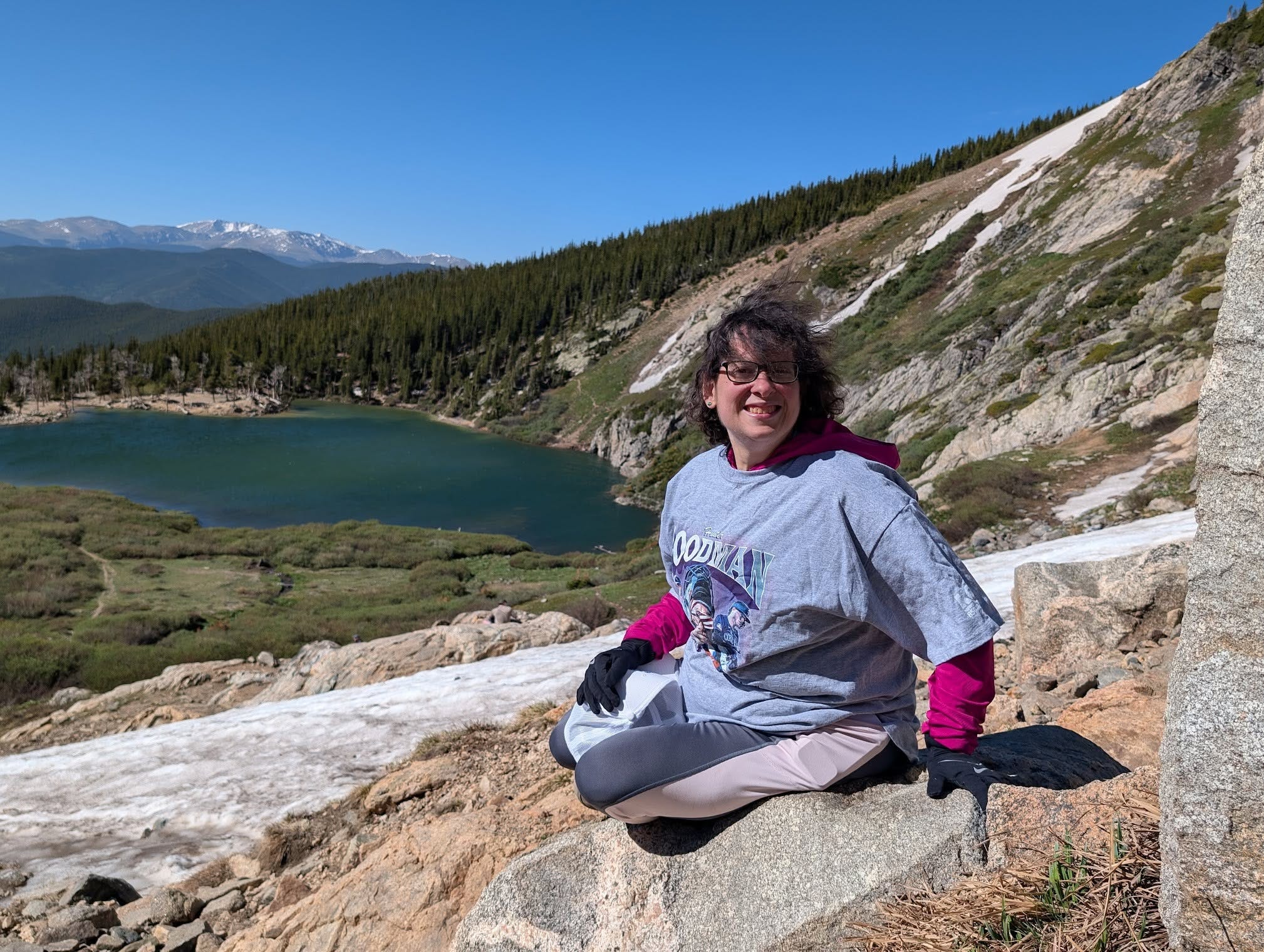
I hiked to St. Mary’s Glacier yesterday; in fact, I hike so much that my husband’s question is not so much when our next hike is, but how much driving is required. Luckily, it was his hobby first. The trail starts above 10,000 feet. The air is thin, and breathing isn’t easy. Rocks ranging from loose gravel to the size of my fist to giant boulders create the trail. And it’s uphill. There’s not a smooth spot in sight. If I saw this trail even a year ago, we would be turning around instantly. And maybe we had to go slow. Maybe I spent more time looking at the ground than at the trees and the sky. Maybe I had to pause for 10-20 seconds at a time to figure out my best route. But at the top, my gosh, was the view worth it, capturing ice, alpine lakes, emerald-green trees, and the bluest Colorado sky all in one gorgeous vista.
We head back down, begrudgingly back to reality. I get more confident, and we chat on the way down. It’s easier. I always say that up is more physically challenging, and down is more mentally challenging.
All of a sudden, my feet go out from under me. I glide like I’m going down a slide. Easily get up and continue.
Paul asks, “Did you fall?” I respond, “I guess,” as I shrug and keep going, with a little more caution. I smile to myself. I didn’t even check for blood running down my leg or even scrapes. I certainly didn’t scream in pain. I didn’t even hesitate. Life didn’t stop, it just…continued.
Keep it moving — that’s what I was trying so hard to maintain when I consistently collected injuries. And now, it just happens. I didn’t even wonder where the nearest emergency room was.
Back in the car, Paul and I evaluate how the hike went. I marvel that I fell and it was okay. Paul posits that comparing now to the past is almost unfair because we are so far from that world. I ponder, and disagree. That past is always part of my story, and the previous reality is what makes today’s routine that could have been a catastrophe so wild. Who would have thought I could be this person?
For decades, uneven ground felt more dangerous than the highest mountain. Not anxiety, not paranoia, but a well-founded fact. My body delivered lessons. I didn’t just study, I treated its lessons as doctrine. The surprising thing isn’t that my physicality improved. It’s that it’s taking years for my self-image to catch up with reality.
People think the hard part is getting stronger, losing weight, and stabilizing kidney disease. But trusting the mounting evidence is the true struggle. The good part is I never cease in being delighted at what I can do, and have endless spreadsheets detailing future adventures I want this body to help me explore. Maybe my body’s not the albatross I’ve always envisioned it to be.